Quick answer
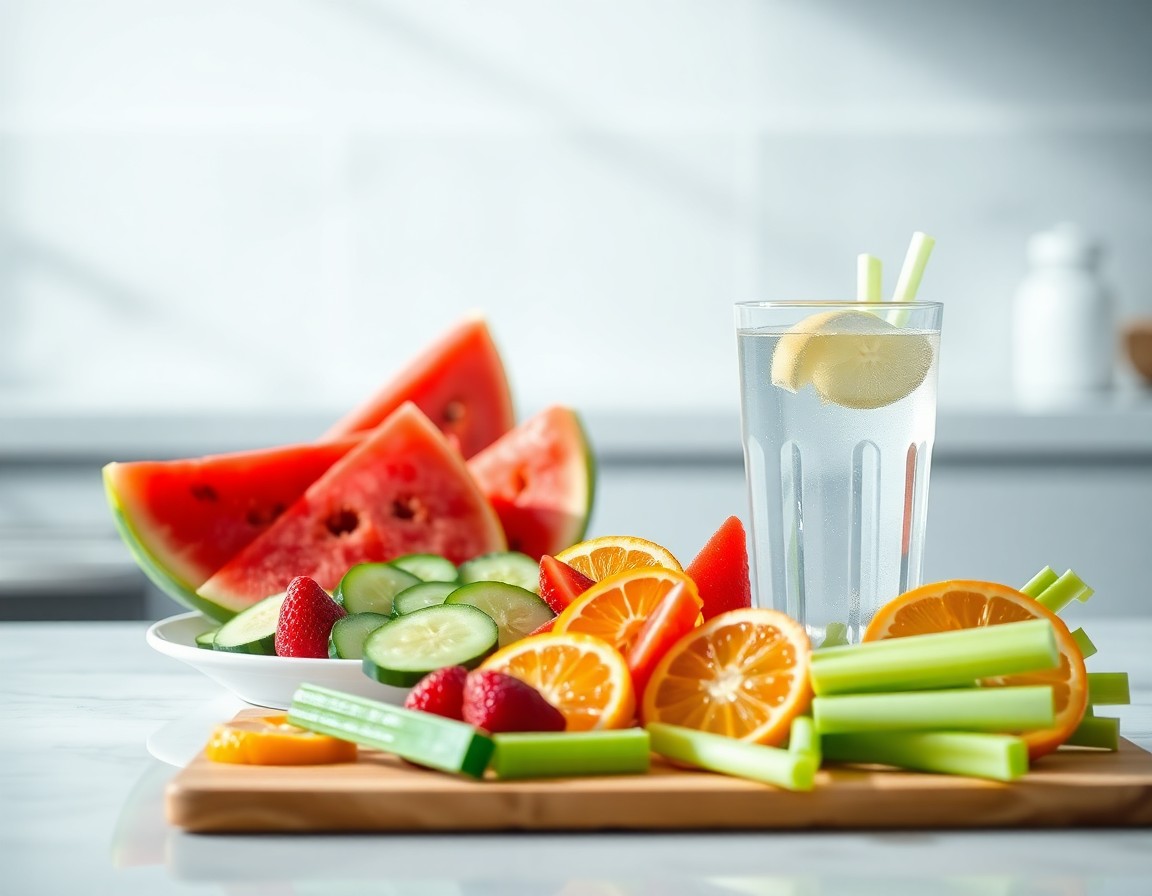
The most hydrating foods are raw salad vegetables: iceberg lettuce, celery, radishes and cucumber are about 95% water, with zucchini and tomatoes close behind. Watermelon, strawberries and cantaloupe lead the fruits at 90–91%, and food overall supplies about a fifth of the water you take in each day.
A cup of watermelon is more than 90% water. So is a tomato, a cup of strawberries and a bowl of chicken noodle soup. Most of us never think of lunch as hydration, yet about a fifth of the water we take in comes from food. Here are 38 everyday foods ranked by water content, with what a typical serving gives you in milliliters and ounces, and whether any of it should count toward your daily goal.
Does food count toward your water intake?
Yes, and the official numbers already include it. The US National Academies count both the water in beverages and the moisture in food: adequately hydrated women take in about 2.7 liters (91 oz) of total water a day and men about 3.7 liters (125 oz), with roughly 80% coming from drinks and 20% from food. A review in Nutrition Reviews puts the US share from food at about 22% and estimates it is much higher in countries such as Greece, where people eat more fruit and vegetables. Our guide to how much water you need per day explains how those totals become a daily target.
None of this makes cucumber a superfood. Its water is ordinary water, counted the same way as the water in your glass; it just arrives with food you were going to eat anyway.
The most hydrating fruits
Melons and strawberries lead the fruit bowl. All figures here come from USDA's FoodData Central database, per 100 grams of food as eaten. A gram of water is about a milliliter, so the last column is the serving's water by volume.
| Fruit | Water | Serving | Water per serving |
|---|---|---|---|
| Watermelon | 91.5% | 1 cup, diced (152 g) | 139 ml (4.7 oz) |
| Strawberries | 91.0% | 1 cup, halved (152 g) | 138 ml (4.7 oz) |
| Cantaloupe | 90.2% | 1 cup, diced (156 g) | 141 ml (4.8 oz) |
| Honeydew melon | 89.8% | 1 cup, diced (170 g) | 153 ml (5.2 oz) |
| Peach | 88.9% | 1 medium (150 g) | 133 ml (4.5 oz) |
| Orange | 86.8% | 1 orange (131 g) | 114 ml (3.8 oz) |
| Pineapple | 86.0% | 1 cup, chunks (165 g) | 142 ml (4.8 oz) |
| Apple, with skin | 85.6% | 1 medium (182 g) | 156 ml (5.3 oz) |
| Blueberries | 84.2% | 1 cup (148 g) | 125 ml (4.2 oz) |
| Pear | 84.0% | 1 medium (178 g) | 149 ml (5.1 oz) |
| Grapes | 80.5% | 1 cup (151 g) | 122 ml (4.1 oz) |
| Banana | 74.9% | 1 medium (118 g) | 88 ml (3.0 oz) |
| Avocado | 73.2% | ½ avocado (101 g) | 74 ml (2.5 oz) |
Watermelon earns its reputation, but only just: strawberries trail it by half a point and cantaloupe by little more than one. Even an apple is over 85% water, and bananas and avocados, at the bottom, are still about three-quarters water.
The most hydrating vegetables
Salad vegetables top the whole ranking. Iceberg lettuce, celery, radishes and cucumber are all about 95% water, and a whole 21 cm (8-inch) cucumber holds about 287 ml (9.7 oz) — more than a standard 250 ml glass. Everything below is raw unless noted.
| Vegetable | Water | Serving | Water per serving |
|---|---|---|---|
| Iceberg lettuce | 95.6% | 1 cup, shredded (72 g) | 69 ml (2.3 oz) |
| Celery | 95.4% | 1 cup, chopped (101 g) | 96 ml (3.3 oz) |
| Radishes | 95.3% | ½ cup, sliced (58 g) | 55 ml (1.9 oz) |
| Cucumber, with peel | 95.2% | ½ cup, sliced (52 g) | 50 ml (1.7 oz) |
| Zucchini (courgette) | 94.8% | 1 cup, chopped (124 g) | 118 ml (4.0 oz) |
| Tomato | 94.5% | 1 medium (123 g) | 116 ml (3.9 oz) |
| Green bell pepper (capsicum) | 93.9% | 1 medium (119 g) | 112 ml (3.8 oz) |
| Cabbage | 92.2% | 1 cup, shredded (70 g) | 65 ml (2.2 oz) |
| Cauliflower | 92.1% | 1 cup, chopped (107 g) | 99 ml (3.3 oz) |
| Spinach | 91.4% | 1 cup (30 g) | 27 ml (0.9 oz) |
| Broccoli | 89.3% | 1 cup, chopped (91 g) | 81 ml (2.7 oz) |
| Carrot | 88.3% | 1 medium (61 g) | 54 ml (1.8 oz) |
| Potato, baked with skin | 74.9% | 1 medium (173 g) | 130 ml (4.4 oz) |
Leafy greens show why percentages only tell half the story. Raw spinach is 91% water, like watermelon, but a cup weighs just 30 grams, so it holds about 27 ml — a sip or two. A cup of diced watermelon weighs five times as much and holds five times the water.
How much water does a serving really give you?
Add up a produce-heavy day and the numbers get surprisingly large. Oatmeal at breakfast (about 196 ml), an apple and a container of yogurt as snacks (about 305 ml together), a lunch salad of two cups of lettuce, a tomato and half a cup of cucumber (about 304 ml), and chicken noodle soup with a cup of rice at dinner (about 342 ml) come to roughly 1.1 liters, or 39 oz. That's more than four glasses of water without a single drink.
For comparison, food's fifth of the US reference values is about 540 ml (18 oz) a day for women and 740 ml (25 oz) for men. A day of toast, cheese, crackers and nuts goes the other way: two slices of white bread, a slice of cheddar, five saltines and 23 almonds hold about 33 ml between them. So food can supply anything from a few sips to more than a liter, depending mostly on how much fruit, vegetables and soup you eat.
Soups, yogurt and cooked grains count too
Fruit and vegetables get the attention, but anything cooked in water or made from milk carries a lot of it.
| Food | Water | Serving | Water per serving |
|---|---|---|---|
| Chicken noodle soup, canned, made with water | 94.2% | 1 cup (248 g) | 234 ml (7.9 oz) |
| Plain yogurt, whole milk | 87.9% | 1 container (170 g) | 149 ml (5.1 oz) |
| Oatmeal, cooked with water | 83.6% | 1 cup (234 g) | 196 ml (6.6 oz) |
| Cottage cheese | 79.8% | ½ cup (105 g) | 84 ml (2.8 oz) |
| Egg, hard-boiled | 74.6% | 1 large (50 g) | 37 ml (1.3 oz) |
| White rice, cooked | 68.4% | 1 cup (158 g) | 108 ml (3.7 oz) |
| Chicken breast, roasted | 65.3% | ½ breast (86 g) | 56 ml (1.9 oz) |
| Pasta, cooked | 62.1% | 1 cup (124 g) | 77 ml (2.6 oz) |
| Cheddar cheese | 36.8% | 1 slice (28 g) | 10 ml (0.3 oz) |
| White bread | 36.4% | 1 slice (29 g) | 11 ml (0.4 oz) |
| Saltine crackers | 5.0% | 5 crackers (15 g) | 1 ml (<0.1 oz) |
| Almonds | 4.4% | 23 almonds (28 g) | 1 ml (<0.1 oz) |
Soup is the obvious one: canned chicken noodle soup made up with an equal amount of water is 94% water, so a cup delivers about 234 ml (7.9 oz), nearly a full glass. Plain yogurt is 88% water and cottage cheese 80%. Cooked grains are the quiet surprise: dry white rice is about 12% water and cooked rice 68%, because the grains soak up their cooking water. Pasta goes from about 10% to 62%, and oats from 11% to 84% as oatmeal. That water counts, even though you never poured it.
Eggs (75%) and roasted chicken breast (65%) sit in the middle, and the USDA-based table in the Nutrition Reviews paper places shrimp, salmon, ground beef and steak between 50% and 79%.
Foods that add almost no water
At the other end sit the dry staples of the pantry. Bread and cheddar are only about 36–37% water, and saltines and almonds barely register, at about 5% and 4%. The same review puts walnuts, peanuts, cookies, cereals, pretzels and peanut butter under 10% too, and oils and sugar at zero. Drying makes the biggest difference: grapes are about 80% water, raisins about 15%.
None of that makes them bad food. They just add little water, so a day built around them leaves more of the work to your drinks.
Who benefits most from water-rich foods
For most healthy adults, water-rich food is a bonus rather than a strategy, but a few groups get more out of it. If a child's water bottle comes home still full, snacks and dinner can make up some of the gap: a cup of strawberries or melon carries over half a glass of water, and a cup of soup nearly a whole one. Our guide to hydration needs by age covers how much kids need.
Thirst can also become less reliable with age. In a classic 1984 study, healthy men aged 67 to 75 felt less thirsty and drank less after 24 hours without water than men aged 20 to 31, so soup, yogurt and fruit at mealtimes are a useful way to add water that doesn't depend on thirst. And if plain water isn't your thing, food can carry part of the load while tea, milk and other drinks do the rest; see the most hydrating drinks for how they compare.
Food does have limits, though. If a hot afternoon costs you an extra liter of sweat, replacing it with watermelon alone would take about 1.1 kg — seven cups or so. Water-rich snacks help on summer days; they don't replace the water bottle.
Should you count food when you track water?
No, and this is the part most “hydrating foods” lists skip: drinking targets already assume that food covers part of your needs. Take 80% of the US reference values and you get about 2.2 liters (73 oz) of drinks a day for women and 3 liters (100 oz) for men, which is where the familiar four to six bottles a day comes from. Our daily water intake calculator works the same way, giving you the amount to drink and showing the total including food separately. Log your salad and soup on top of that and you'd count the same water twice.
Food still shapes how much you need to drink. Eat little fruit, vegetables or soup and your drinks have more to make up; fill your plate with them and the glass has less to do. Either way, the National Academies concluded that the vast majority of healthy people meet their needs by letting thirst be their guide, along with the drinks they habitually have at meals.
Realwater sticks to drinks, too: it tracks what you drink, not what you eat. Your daily target comes from your weight, activity and climate and shifts on hot or heavy-training days, a quick-add chip logs your usual glass, bottle or mug in one tap, and every drink counts with its own hydration value, so coffee and tea count honestly. The fruit bowl stays a bonus you never have to log. So enjoy the watermelon: it's about 91% water, and it's already built into the math.
This article is for general information and isn't medical advice. If you have kidney, heart, or other conditions that affect fluid balance, or take medications that do, follow your doctor's guidance on fluid intake, including how to count soups and other water-rich foods.