Stand in front of the fridge with a glass in hand and you face a small daily decision: fill it from the tap, pour from the filter pitcher, or crack open a bottle. Marketing would have you believe the choice matters enormously. For hydration it doesn't matter at all — and for everything else, the differences are real but smaller and more practical than the labels suggest. Here's a clear-eyed tour.
Hydration-wise, they're identical
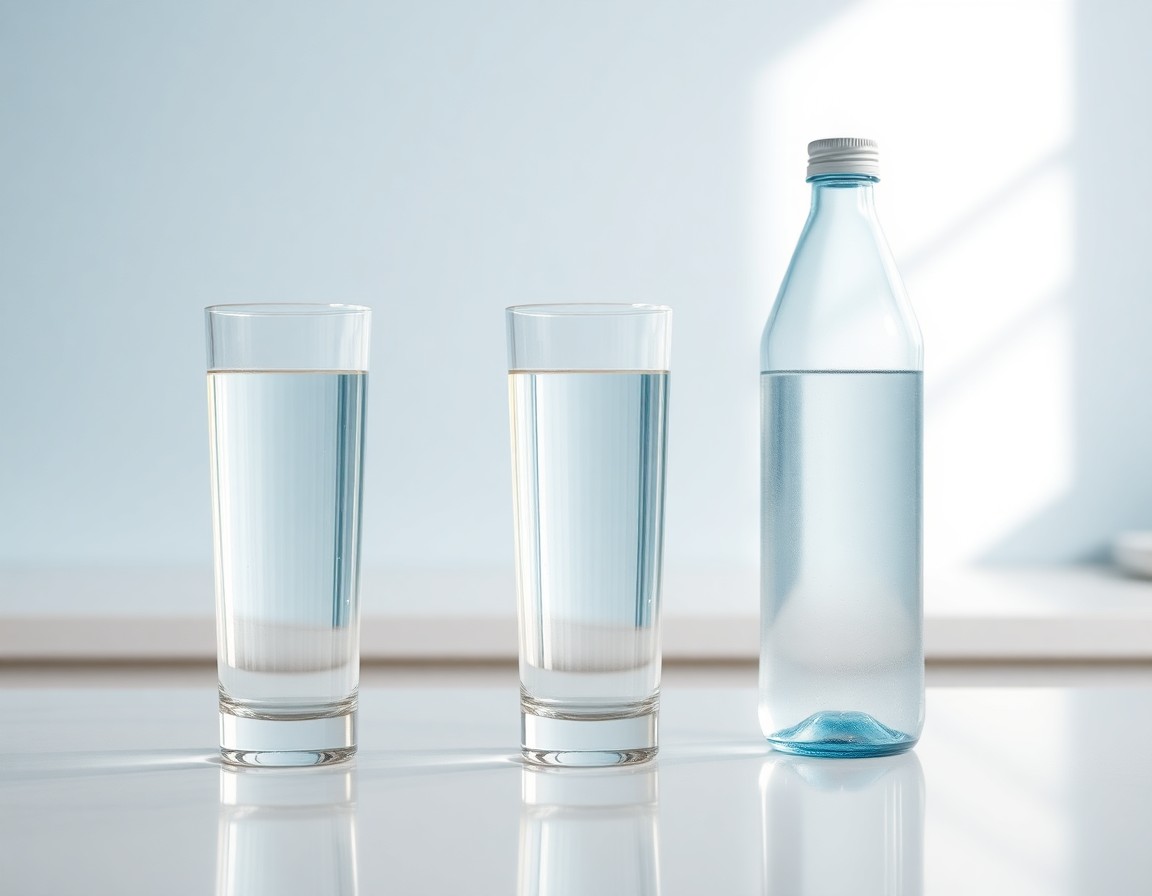
Your body doesn't care where the water came from. Tap, filtered, bottled, still, sparkling — once it's past your throat, water is water. It's absorbed through the small intestine at the same rate and does the same job regardless of the source. No study has ever shown that one kind of drinking water hydrates you more effectively than another, and none is likely to, because there's nothing in the physiology that would make it so. Whatever the bottle says about “purity” or “alkalinity,” the hydrating ingredient is the same H₂O that comes out of your kitchen tap. If you want to sort the marketing from the science more broadly, our hydration myths post covers the usual suspects.
What does differ is taste, mineral content, cost, safety in specific situations, and how much of it you end up drinking. Those are worth thinking about — just not for the reason the ads imply.
Taste and chlorine
Most public water supplies are disinfected with chlorine or chloramine, which is why some tap water carries a faint swimming-pool note. It's harmless at the levels used, but it is the single biggest reason people say they “don't like” tap water. The good news is that it's easy to fix. Chlorine dissipates on its own if you leave a jug of water in the fridge for an hour or two, and any carbon filter removes it almost completely. Chloramine is more stubborn and needs a filter specifically rated for it. Cold water also simply tastes better to most people, which is why the same tap water often seems fine once it's been chilled.
Minerals: a small but real difference
Tap and bottled waters vary widely in their dissolved minerals, especially calcium and magnesium. Hard tap water and some European mineral waters can contain enough to make a modest contribution to your daily intake — a liter of hard water might supply a tenth or so of your magnesium needs, and some mineral waters more. Soft water, distilled water, and reverse-osmosis water contain very little. That's a nutritional footnote rather than a reason to choose one over another; you'll get far more of both minerals from food. It does explain why waters taste different, though, and why some people find very low-mineral water oddly flat.
What filters do and don't do
The pitcher filters most people own use activated carbon, sometimes paired with an ion-exchange resin. They're good at what they advertise: removing chlorine, improving taste and odor, and reducing some organic compounds and, with the resin, a portion of metals like lead and copper. They are not sterilizers. A basic carbon pitcher doesn't reliably remove bacteria, viruses, nitrates, fluoride, or most dissolved salts, and a filter left past its change date can start to harbor the very microbes it isn't designed to catch. Change cartridges on schedule and keep the pitcher in the fridge.
If you need more than taste improvement — say, your home has known lead plumbing — look for a filter certified against the specific contaminant you care about (in the U.S., an NSF/ANSI 53 certification listing lead, for example). Reverse-osmosis systems remove far more, including most minerals, at the cost of wasted water and a slower fill. For most households on a treated municipal supply, a carbon pitcher and a cold fridge cover everything that actually affects the experience of drinking a glass of water.
Bottled water: cost and plastic
Bottled water is safe, convenient, and expensive. Depending on the brand and country it costs hundreds to a couple of thousand times as much per liter as tap water, and a fair share of it is simply municipal water that has been filtered and bottled. Someone drinking two liters a day from single-use bottles is spending real money and generating roughly 700 bottles a year of plastic, only a fraction of which is recycled. There are legitimate reasons to buy it — travel, emergencies, a supply you don't trust — but as an everyday habit in a place with good tap water, it's mostly paying for the packaging.
The microplastics question
Studies over the past few years have found microscopic plastic particles in bottled water, generally at higher concentrations than in tap water, and newer techniques have detected even smaller nanoplastics in surprising numbers. What that means for health is honestly unknown. Nobody has shown harm at the levels found in drinking water, but nobody has shown safety either, and the research is young. The World Health Organization's position is that there's no evidence of risk yet and that better data is needed. If it worries you, choosing tap or filtered water over bottled is a reasonable hedge that costs you nothing. It isn't a reason to panic, and it's certainly not a reason to drink less water.
When tap water isn't the right call
There are situations where the default flips. When you travel somewhere the local supply isn't reliably treated, sealed bottled water — or boiled, or properly filtered water — is the safer choice, and that includes ice and the water you brush your teeth with. If your utility issues a boil-water notice after a main break or flood, follow it: bring water to a rolling boil for a minute before drinking. And if you live in an older home, particularly one built before the 1980s, it's worth finding out whether the service line or interior plumbing contains lead. Lead doesn't change how water tastes or looks; a test kit or a call to your utility is the only way to know. Running the tap for thirty seconds before filling and using cold water for drinking and cooking reduces exposure while you sort out a certified filter or a pipe replacement.
The real answer: the water you'll actually drink
Once safety is covered, the only variable that meaningfully affects your hydration is how much you drink, and that comes down to whether you like the water in front of you. If chilled filtered water gets you to two liters a day and warm tap water gets you to one, the filter is doing something worthwhile even though it changes nothing about the water's hydrating power. The same goes for a bottle you enjoy carrying, or a squeeze of lemon, or sparkling over still. Preference isn't vanity here; it's the mechanism. It's also why water, however sourced, beats reaching for a soda: our post on water vs. sugary drinks explains what the sugar costs you.
So pick the source you'll come back to, and then track the thing that matters, which is volume. The daily water intake calculator gives you a sensible target for your size and activity, and the water unit converter helps if your bottles are in ounces and your goal is in liters. For the reasoning behind those targets, see how much water you actually need per day. Realwater exists for the step after that: it turns your target into a sphere of water on your phone and fills it a glass at a time, so the question stops being tap or bottled and becomes simply whether the level is where it should be by evening.