Quick answer
About 4 to 6 standard 16.9 oz (500 ml) bottles a day covers most adults — roughly 2 to 3 liters, or 68 to 101 oz. US guidance works out to a little over 4 bottles for women and about 6 for men, and coffee, tea and other drinks count toward the total.
Hydration advice is usually written in liters or glasses, but most of us actually drink from bottles: the 16.9 oz bottle from the fridge, the 20 oz from the vending machine, the 40 oz tumbler that follows you from desk to car. So the useful question isn't how many liters you need — it's how many of your bottles. Here's the answer for every common size, plus the gallon question that usually comes next.
The short answer: about four to six bottles
US guidance from the National Academies puts total water — from drinks and food combined — at about 2.7 liters a day for women and 3.7 liters for men. Roughly 80% of that comes from what you drink, which leaves about 2.2 liters (73 oz) of fluid for women and 3 liters (100 oz) for men. In standard 16.9 oz bottles, that's a little over four bottles for women and about six for men. European guidelines land lower, at 2.0 liters a day for women and 2.5 for men — four and five bottles' worth.
Treat those numbers as starting points, not prescriptions. They describe healthy adults in temperate conditions, and the same US report notes that the vast majority of healthy people meet their needs simply by drinking when they're thirsty. A bigger body, hard training or a hot day pushes the number up; a smaller, less active person in a cool office may need less. For a target tuned to your weight, activity and climate, try the daily water intake calculator.
It doesn't all have to be plain water
Here's what makes the bottle count less daunting: those figures cover all fluids, not just water. Tea, milk, sparkling water and yes, even coffee all count, and the remaining fifth of your water arrives in food — fruit, vegetables, soup, yogurt. A mug of coffee and a glass of milk at breakfast already add up to about one bottle's worth before you've unscrewed a cap. “Bottles of water” is shorthand for the total you drink, not a quota of plain water on top of everything else.
Why water bottles are 16.9 ounces
If you've ever wondered about that oddly specific number on the label, it's because the bottle is metric. One US fluid ounce is 29.57 ml, so a 500 ml bottle converts to 16.9 oz. The same logic gives you 33.8 oz for a liter bottle and 50.7 oz for a 1.5-liter one. The 20 oz bottle, the other common size in US stores, is the odd one out: it's a true ounce size, about 591 ml.
Two anchors cover most of the math. One 16.9 oz bottle holds exactly two standard 250 ml glasses, and four of them make 2 liters — the classic eight glasses.
How many bottles a day, by bottle size
Here's how many bottles it takes to reach three common daily targets. Two liters is a sensible baseline for many adults, 2.5 liters sits in the middle, and 3 liters matches US guidance for men — or a hot, active day for almost anyone.
| Bottle size | 2 L (68 oz) | 2.5 L (85 oz) | 3 L (101 oz) |
|---|---|---|---|
| 12 oz (355 ml) | 5.6 | 7 | 8.5 |
| 16.9 oz (500 ml) | 4 | 5 | 6 |
| 20 oz (591 ml) | 3.4 | 4.2 | 5.1 |
| 24 oz (710 ml) | 2.8 | 3.5 | 4.2 |
| 32 oz (946 ml) | 2.1 | 2.6 | 3.2 |
| 33.8 oz (1 L) | 2 | 2.5 | 3 |
| 40 oz (1.18 L) | 1.7 | 2.1 | 2.5 |
Fractions are fine: 3.4 bottles of the 20 oz size just means three bottles plus a glass of something else — that afternoon tea counts. For any other size or target, the water unit converter does the math in both directions.
Big reusable bottles and tumblers
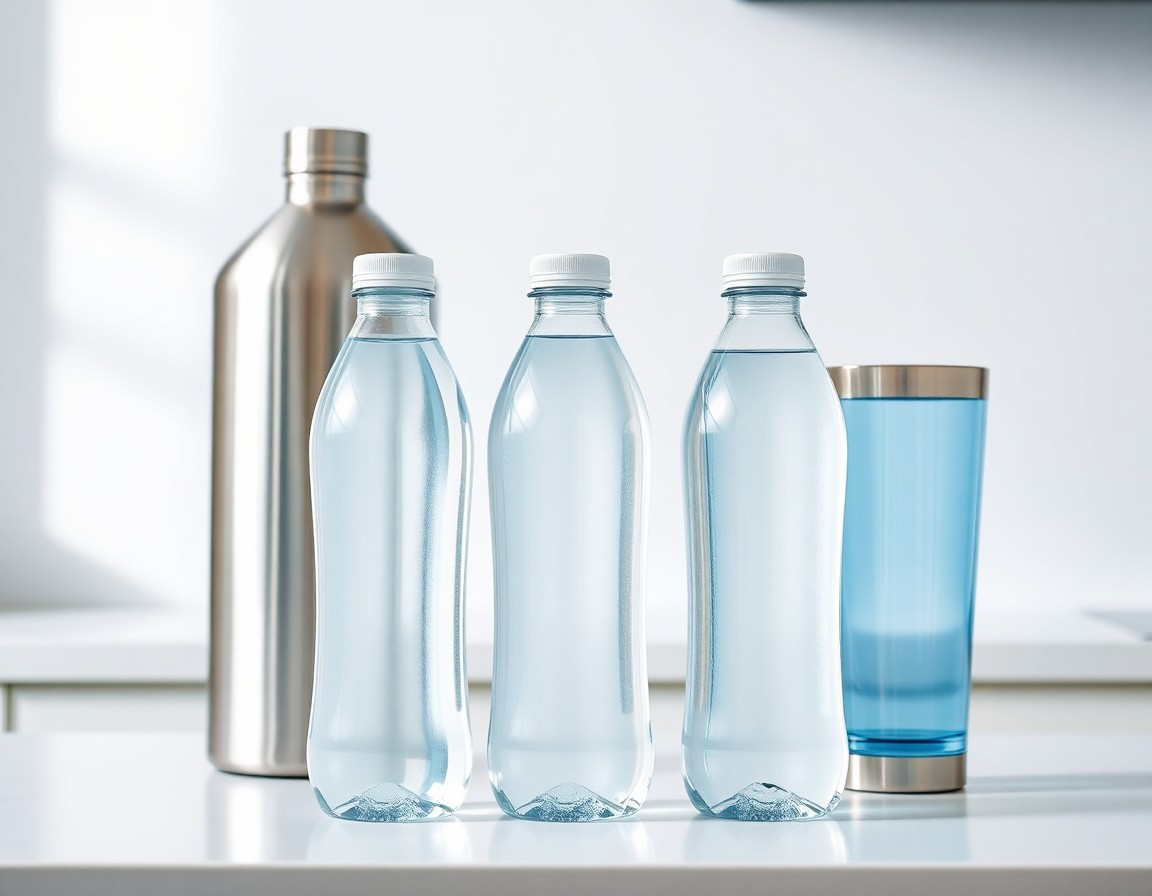
Refillable bottles shrink the count fast. A 32 oz bottle filled twice is 64 oz — the eight-glasses-a-day amount, a rule that, for the record, has never had much science behind it. A 40 oz tumbler filled twice gets you 80 oz, about 2.4 liters: enough to cover the US figure for women and most of the one for men. And a half-gallon (64 oz) jug, filled once, does the whole eight-glasses job by itself.
One catch with big bottles: the number on the label is capacity, not what you drink. Most people fill to an inch or so below the brim, and a tumbler packed with ice holds noticeably less liquid until the ice melts. If your 40 oz tumbler really holds 34 oz the way you fill it, two refills are 68 oz, not 80. Measure your real fill line once with a measuring jug and you'll know your true number.
How many bottles make a gallon?
A US gallon is 128 fluid ounces, or about 3.8 liters. In bottles, that's:
- 16.9 oz (500 ml) bottles: about 7½
- 20 oz bottles: about 6½
- 32 oz bottles: exactly 4
- 1-liter bottles: just under 4
- 40 oz tumblers: a little over 3
A UK (imperial) gallon is bigger, at about 4.5 liters — just over nine 500 ml bottles.
Is a gallon of water a day too much?
Gallon-a-day challenges are popular, so it's worth being clear: for most people, a gallon is more than they need. It's well above the US figure for women (about 73 oz of fluid) and still above the one for men (about 100 oz) — before you count the water in food. Long, sweaty training days, outdoor work in the heat or a large body can genuinely call for that much. On an ordinary office day, the extra mostly buys you more trips to the bathroom.
For healthy adults, the bigger issue is pace rather than the total. Spread across a 16-hour waking day, a gallon works out to about 8 oz an hour — a steady trickle, not a flood. Trouble comes from drinking large amounts in a short window, which can dilute the sodium in your blood; our guide to how much water is too much explains where that line is. And if you have a heart, kidney or liver condition, or a doctor has asked you to limit fluids, skip the challenge entirely.
Turn your number into a bottle routine
The best thing about bottles is that they make a daily target countable. Pick the bottle you actually carry, divide your target by its size, and spread the refills across the day. With four 16.9 oz bottles, that might be one by mid-morning, one by lunch, one mid-afternoon and one with dinner. With a 40 oz tumbler, it's one before lunch and one before you leave work. Checkpoints beat a single end-of-day total, because falling behind at 3 p.m. is easy to fix and falling behind at 9 p.m. means a long night.
Keep the bottle where you can see it and refill it the moment it's empty. Then let your body fine-tune the target: if you're rarely thirsty and your urine is usually pale yellow, your number is about right — and if not, it's worth knowing the subtler signs of dehydration.
Realwater is built around exactly this. Add your bottle as a quick-add size once, and from then on a single tap logs a full bottle while the water sphere fills toward your goal. Your target comes from your weight, activity and climate, so it shifts on hot or heavy-training days — and reminders stay quiet while you sleep and skip the nudge if you just drank.
So: four bottles is a sensible default for many adults, five or six suits bigger, more active people and hot days, and a gallon is more than most people need on an ordinary day. Whatever your number, count it in the bottle you actually carry.
This article is for general information and isn't medical advice. If you have kidney, heart, or other conditions that affect fluid balance, or take medications that do, follow your doctor's guidance on fluid intake.